|
Article by
Welsh Contemporary Artist
Keith Bayliss
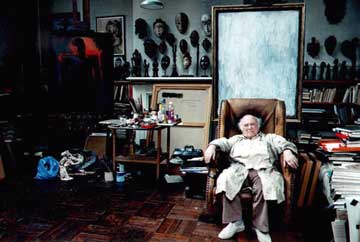
Josef Herman in his studio in London (Photograph © Bernard Mitchell)
|
This page is kindly supported by
|

|
'
The will to live, to dream and to assert the values of the human heart - this is all I try to communicate to others.'
Josef Herman. 1911 - 2000.
The image impressed me. The woman sits solidly central. A monumental figure, timeless. She is every woman. A mother. Hands like shovels, able to defend and protect, a workers hands. Wrapped snug and tight, the baby is held close to the heart. In the shawl that binds mother to child they become one. I know that feeling. I remember it still after many years. In some Eastern European countries babies are wrapped tightly, bound like little parcels, independent units. In Wales they were bound in wool by the shawl that enveloped both child and mother. Two become one, a single unit.
(A contemporary Welsh artist -
Nigel Williams
- uses the shawl as a metaphor for the security and warmth of his childhood in Ystradgynalis in the Swansea Valley -
CLICK HERE
to read about, and view, his work)
The image to which I refer, that struck such a chord in me as an older child, was painted by Josef Herman.
Familiarity dulls the vision. Sometimes a fresh or independent eye can appear to see more, it can strike to the heart of the subject enabling others to view more clearly another side of the story, another slant on life and the human condition.
Herman arrived in Wales in 1944. A Polish Jew, a refugee born in the Warsaw ghetto in 1911, fleeing from the Nazi tyranny engulfing Europe.
He found a home in Wales, at Ystradgynlais in the Swansea Valley, and a people who fitted perfectly as subject matter. But Herman was not a cold observer of industrial village life in Wales. He was a passionate and compassionate maker of icons, images that go beyond the representative.
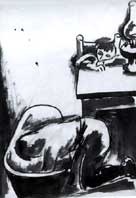
"Miner Bathing" by Josef Herman
His miners are rarely depicted as individual personalities or as the clichés images that were to become the norm in artistic circles in Wales. His miners are symbols for every man. Images made in Wales but able to be understood universally.
Herman talked of seeing a
'sadness and grandeur'
in his subjects and said that this became the source of his work and influence for the rest of his life.
These qualities are especially evident in the many exquisite drawings executed in Wales during this time. In many of his works the eyes, reduced to basic ovals, remind me of the work of Modigliani. Both artists displayed a profound respect for humanity and a desire to find and depict that which makes us human, the vulnerability and the strength, resignation without defeat.
His images are constructed in broad strokes of the brush, building solid figures that are not without life. They crouch and huddle, in the characteristic postures of working men, a poetry of gesture captured by the artist. His colour is low key and at its best is able to radiate a rich glow matching the monumental stillness of the figures.
'I like the miners and I like living among them' and 'I want my studies of miners to be more real than portraits'
he stated.
Herman responded instinctively to the village and country in which he found himself living and in which he made a temporary home. The effect was profound and long lasting.
The story of his
'vision'
on the bridge at Ystradgynlais is well known to many and reveals much,
'Then unexpectedly, as though from nowhere, a group of miners stepped onto the bridge. For a split second their heads appeared gaunt against the full body of the sun
With the light around them, the silhouettes of the miners were almost black. The magnificence of the scene overwhelmed me.'
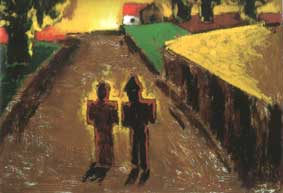
"Yellow Tree - Ystradgynalis" by Josef Herman
He left Wales in the mid 1950's, set up home in England and travelled quite extensively, visiting Japan, Spain, Portugal, Italy and France among other countries, but always drawing on the human qualities he found in those who toil on the land or under it.
He made many friends in Wales, the artist
Will Roberts
, who shared a parallel vision, being one of them. Herman influenced and inspired many and left behind him a body of work displaying the qualities of spirit and character still, I hope, to be found in the best of us. He has left us richer.
Keith Bayliss.
|