|
|
"Conservation Crop" - plastic and dried grass 30" x 30" multiole construction.
|
REGISTERING THE LAND
An Exhibition of Work by
JOHN HOWES
At Oriel Lliw Gallery,
Pontardawe.
For the last thirty years John Howes and his wife, a painter, has lived on the Gwrhyd Mountain just northwest of Pontardawe in the upper Swansea Valley, combining a career as artist, designer, farmer, lecturer and musician.
Their 70 acre farm of Blaen egel is typical of the marginal farming that comprises much of the agricultural landscape of Wales and is stocked with sheep with most of the land put down to grass for forage and conservation. He has a concern for this landscape and for the protection of the environment and it has provided inspiration for much of his creative output. In 1996, having paid off the mortgage, they received a parcel through the post from the building society enclosing the title deeds to the property. This set of documents was to prove the catalyst for the creation of this latest series of works exploring the processes of management, documentation and representation of agricultural landscapes.
BLAENEGEL
Blaenegel Fawr and Fach fell within the district of Blaenegel, one of the four administrative areas of the ecclesiastical parish of Llangiwg in the Manor of Gower Supraboscus. The farm takes its name from the Egel stream which rises at 1,000 ft above Ordnance Datum on co-ordinates 2738/2107 on the Penll'er Fedwen Mountain and flows down the west shoulder of the Gwrhyd Mountain through Fforch Egel and under the Graig Ddu precipice in a general southwest direction to Ynys Wen and thence south into the east bank of the Lower Clydach river at Rhydyfro on 2713/2058 at 320 ft above Ordnance Datum.
The earliest recorded reference to Blaenegel is in 1584/5 when two entries appear in the Peniarth 120 manuscript held at the National Library of Wales.
Blaen - source of streams or rivers, Egel - sow bread, a kind of cyclamen.
"His claim to the land of
Blaenegel is temporal and
his effect on the land is limited
As an artist
he can claim it creatively
while as a farmer
he can only care for and use
its '66 acres or thereabouts' until
he too is part of its history"
Shelagh Hourahane
LANDCAPE - FRAGMENTS LEFT BEHIND
An Essay by
SHELAGH HOURAHANE
I went back, the other day, a day of calm mellowness before the first driving autumn low arrived. Of course the landscape hadn't changed in a year, although the feel of it had. There was still the rough texture of strewn rock-slopes and the shattered shapes of hills across the skyline. The house still evoked surprise, appearing below the last rise on the tortuous track, settled securely in its inevitable place. Yet the name of the farm, Cae Heuad, seems to belie the nature of the land, at nearly one thousand feet on Robell Fawr. It has a field that had customarily been sown, cultivated rather than left to pasture and so this 'sown field' had given the farm its title. For eight years I had tried to possess this place, making it the subject of my writing and my art. I was driven by a need to identify with the land in which I had come to live and this was, for me, the best way to do so. I found objects that were etched with meaning, of previous farming and domestic life. I pictured individual trees, endless stonewalls and other remnants of ways of living on and of working the land. For me the land is the minutiae that inhabit a place, that mark out its boundaries, point to its history. It is made from the layers of people's lives
Lucy Lippard, the eminent and thoughtful American critic has drawn attention to the importance of what she calls the 'art of place'. This should not be confused with the much bandied about phrase a 'sense of place'. The latter tends to refer to personal roots and experience, while Lippard means that we should, as artists, respect what others feel and think. In respect of the land it is important to consider whose place it is and that it may mean something very different to the varied people who use it. If it is other people's land we are removed from its direct experience. However if at the same time that we own it and work it we use it as the basis for artwork the relationship is complex and much more significant
Names that have been used and attached to a place for a long period of time do create continuity, although they may arise from a precise point in its history when a specific activity was vital to that land. We name places because we want to be able to identify them and to differentiate one place from another, but they tell of legends, stories, customs and of the underlying topography and nature of the soil. To map the land is also about possession and knowledge. Land comes with deeds, boundaries and responsibilities. A field that a farmer knows because of how it performs, what it yields for crops or pasture is identified by the lawyer as a portion of a holding, a numbered plot and by the surveyor as a compass position. For their various purposes they all make maps, which are schematic pictures. An artist may pull some of these paradoxes together and in the process create yet another way of identifying a place. If the artist also happens to own the land, the creative reality will be tinged with these other ways of knowing.
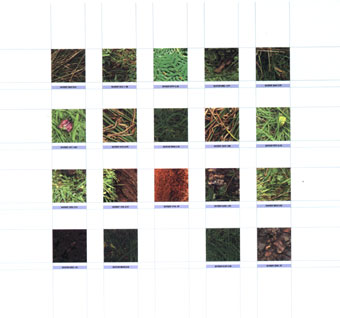
"66 Acres or Thereabouts" - inkjet print on paper 20" x 20" set of four by John Howes.
All farmland is a repository for discarded objects. Broken or fragmented parts of ordinary tools and vessels will lie alongside those of prized objects. A shard of pottery or a piece of iron will be a mute clue or reminder until it is relocated in a museum, in a work of art or by its renaming in a poem. The process is one of revisitation and even of resurrection.
On the face of it much of modern farming practice and the methods and things that are used on farms emphasise the homogenising effect that contemporary life has had on the rural environment. Hayricks have vanished from our countryside and with them some specific practices associated with them. For example, in the village of Newborough in Angelsey there was once a flourishing industry for weaving covers for ricks, using the marram grass that grows on the nearby dunes. This was a very particular situation, which resulted in the practice of a highly specialised craft. However the silage roll has replaced the hayrick in our landscape and with it an excess of ubiquitous black polythene film. Farmers are not allowed to dispose of this material by burial or other means, although tattered strips tend to make unplanned appearances, decorating fences. The brightest future for this unwanted product of agriculture is that it can now be recycled by a process that makes artificial timber boards. With its monotonous blandness and lack of texture and perversity of form black plastic is about as uncongenial a material as can be imagined for making works of art and the effort to fashion it into some type of meaningful form is palpable. In the process the farmer and the artist coincide in the necessity of the one and the creative impulse of the latter. For the outsider the result may become a symbolic statement that draws us into the politics of managing the modern countryside.
My first visit to Blaenegel Farm was on an autumn day that was surprising in its warmth. The Howes farm is in a landscape that has striking qualities that could be hard in less clement weather. It lies in the rough uplands on the brink of the settled ribbon valleys that are scoured out by industry and littered with its remnants. Habitation is clotted in the bottoms, leaving the windy tops to a few farmers and their animals. The long firm ridges undressed with vegetation, bear the marks of many generations of grazing and management. John Howes claim to the land of Blaenegel is temporal and his effect on it is limited. His land belongs to a history of different owners and of changes in the landscape and in its management. As an artist he can claim it creatively and can make those connections while as a farmer he can only care for and use his 66 acres or thereabouts and then leave it so that he too is part of its history.
Shelagh Hourahane October 2002
Shelagh Hourahane is a free-lance writer, researcher, artist and lecturer. Born in Cardiff, she was for many years a full time lecturer in Art History at the University of Wales, Aberystwyth.
She has been active as an exhibition researcher and writer on contemporary art in Wales since the late 1960s. She has written widely including articles on public art in Wales, individual contemporary artists and the landscape. The latter topic has become the main focus of her writing and recent art work. In the early 1980s she was largely responsible for the foundation of the Welsh Sculpture Trust, now known as Cywaith Cymru.Artworks Wales. In 2001, with Lynne Denman, she established Creu-ad, an artist group who work on community and interpretive projects in rural Wales.

|
|
We have been given permission to reproduce the essays written to accompany this exhibition. We are extremely grateful to John Howes
,
Robert Newell
and Shelagh Hourahane.
LANDSCAPE - THE UNPAINTED AND THE PAINTED
An Essay by
ROBERT NEWELL
Documentation can be valued as the antithesis of expression. It offers. the promise of neutralising subjectivity in order to achieve a more valuable and immediate relationship with its object. This relationship can be regarded in certain critical contexts as one of greater value than those alternative forms of self-expression that occlude or diminish their object while emphasising the subjectivity of the author or artist. Partly for this reason, environmental or land art tends to be presented as a paradigm of creative activity that supersedes the supposedly outworn traditions of landscape painting. The unpainted landscape can be regarded as nature, while the painted landscape can be regarded as outmoded culture. This view is underpinned by certain strands of environmental philosophy and aesthetics. These promote aesthetic values taken to be inherent in environmental experience conceived independently, or in explicit differentiation from, the aesthetics of art, and of painting particularly. The possibility that new dimensions of aesthetic understanding might be opened up by formulating an autonomous aesthetics of environment constitutes a most exciting and worthwhile project. The value of this is undermined however if the conception of landscape painting and related aesthetics against which it constructs itself is false.

"Aftermath" by John Howes
Aspects of both form and content are addressed within this debate. In terms of its formal means and limitations, we repeatedly encounter the assertion that landscape painting deals with nature only by resolving it into static images that exclude its inherent dimensions of temporal processes. Environmental art, as a multi-media practice, can seem to be more appropriate to the multi-sensual experience of nature. In terms of content the Western conception of landscape, supposedly saturated by the conventions of painting, has been charged with being ideologically flawed as a medium for sustaining bourgeois hegemony, conventionally circumscribed by the privileging of sight, masculine gender specific, and destined mainly for kittens in the contemporary context. The scenic values promoted by this tradition are said to exclude the non-scenic and thus to devalue those aspects of the environment held to be incompatible with the 'picturesque'. The plight of landscape both as a concept and as an artistic practice appears in this light to be particularly bleak.
If we allow that painting constitutes a kind of visual language, and if we take the analogy further with the suggestion that in many important respects, its meanings are constituted metaphorically, then it becomes possible to understand how flawed the formal argument against painting actually is. Important ways in which painting can function metaphorically through its formal qualities include the expression of movement and time, as well as the expression of multi-sensual experiences. If painting is a visual language, this does not mean that its content is restricted to the visual.
The relationship between culture and nature has a specific social dimension in the polarisation of the relationship between urban and rural life and culture. Occupational and economic specialisation and social and regional differentiation has developed this polarisation throughout human history since the first cities were evolved. High art in differentiation from folk art and the crafts has been typically a city based, socially and economically privileged phenomenon. Landscape painting has been particularly associated with the Outsider's pleasure taken in travel, exploration and tourism. Art, nonetheless, has significantly mediated the relationship between urban and rural cultures, with painting having played a positive part. The history of landscape painting makes more sense if viewed in this way than when articulated within Marxist related paradigms as being a reactionary and redundant practice. Environmental aesthetics cannot achieve the coherence required if it continues to castigate landscape painting. It is now necessary to see that environmental aesthetics, land art and landscape painting all contribute to a positive awareness and valuation of the landscape environment.
Agriculture and aesthetics meet at the apprehension of pattern and coherence in landscapes that have been shaped with human agency. Land Art often engages with certain techniques and crafts of land cultivation, revealing dimensions of meaning and association latent within them. Being both farmer as well as artist, John Howes has valuable insights into this cross-fertilisation of concerns. The land is a vast nexus of signs whose meanings are integral to their material embodiment. Words and objects, map references and actual sites are brought into a juxtaposition in Howes' work that gives them a mutually transformative influence. 'Registering' indicates ways in which different approaches are taken to recording, representing and documenting an area of land with some intention to fix or stabilise it as an object of reference. Different levels of abstraction and different types of information are brought into collision with each other. This is very different from looking to the land mainly as a source of aesthetic pleasure. Certain strands of land art emphasise the decoratively aesthetic aspects of natural materials and processes. Howes subordinates such aesthetic concerns and yet often rediscovers them as a by-product of documentary processes and associative responses in which media characteristics and material sources combine in a fresh synthesis.
Robert Newell
was born in Wimbledon in 1952 and studied Fine Art at Wimbledon School of Art and Goldsmiths College.
Among other places, Newell has taught at Hounslow Borough College, North Devon College and, since 1993, has been a lecturer at Swansea School of Art and Design.
Newell's work in painting and drawing has passed through certain distinct phases in relation to places, themes and formal concerns. Its ultimate concerns centre on the rhythmic organisation of detail and mass produced in landscapes by the interplay of physical forces over time. In relation to varying conditions of light and atmosphere, these visual elements express a certain character contributing to the totality of the landscape's aesthetic power.
Newell has exhibited work in a range of venues including Royal Academy Summer Exhibitions, Glynn Vivian Art Gallery, other galleries in Wales, London and Dusseldorf, etc.
Our address for snail mail:
Room 3,
Queen's Building,
Cambrian Place,
Swansea SA1 1TW
Tel:
or Mobile: 07977 951168
E-mail:
|