|
CERI RICHARDS
'A GREAT WELSH ARTIST'
A New Book by Mel Gooding
Ceri Richards was born in Wales in 1903 and lived for most of his life in London. A draughtsman of genius and a painter of rare energy and imagination, Richards trained at the Royal College of Art in the mid-1920s, where began his fiercely intelligent life-long engagement with modern European art. He read and was deeply affected by Kandinsky, and responded with profound intelligence to Picasso, Matisse and Ernst. Later, he was to extend his creative scope to include Rubens and Delacroix, and to assimilate poetry and music to his artistic purposes. His restless imagination was constantly fed by the most intent and assiduous attention to the energies and forms of the natural world.
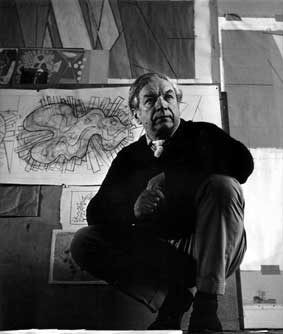
Image © Bernard Mitchell 2002.
In the 1930s Richards made a number of relief constructions and paintings that constitute a major contribution to symbolic Surrealism and rank with the best European art of the period. A great deal of his work in the 1940s continued to give a surrealist inflection to an apocalyptic imagery that identified the cataclysm of the war with the cyclic drama of nature. In art and poetry - in Rubens' Rape of the Sabines and Delacroix's Lion Hunt, in the poetry of Dylan Thomas - he found mythic allegories of sex and violence, procreation and destruction that constituted a complex and utterly original poetic response to the events of the time. In the late '40s and early '50s, in paintings and drawings of music room interiors, of London costermongers and, for the 1951 Festival, of Trafalgar Square, Richards developed an intensely lyrical vision of the everyday world in which brilliant colour, refracted light and an exuberant visual music are components of domestic or urban joy. In the late 1950s and early '60s he made a series of great semi-abstract seascapes on the theme of La Cathedrale Engloutie, which match the lyricism and sombre sonorities of Debussy's prelude. Later he made a number of paintings, lighter in mood and more graphic in treatment, of other themes - Clair de Lune, Jardins sous la pluie, drawn from Debussy.
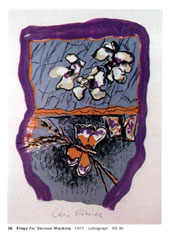
'Elegy for Vernon Watkins,' Lithograph 1971. Ceri Richards Graphics, National Museum of Wales 1979.
Richards, himself a gifted musician, was unusually responsive as an artist to music and poetry. His extraordinary versatility enabled him to shift styles and to treat his subjects and themes with a dazzling virtuosity. Few artists of his time have encompassed such oppositions of subject and mood. But for all its diversity of imagery and its variations of mood there is underlying coherence to all Richards's work. It is to be found in the constant recurrence of visual motifs and symbols, always associated with the mythic cycles of nature and of human life, or with the other great theme of his life's work, the central necessity of art to human existence: these figures include the human form, the arabesque, rock formations and plant forms, sun, moon and roundel, seed-pod, leaf and flower, and musical instruments, especially the piano. It is to be found, too, in a constant inventive brilliance of technique and execution, a characteristic clarity and certainty of image that derives above all from a graphic gift that matches those of the great predecessors, Delacroix, Matisse and Picasso, to whom he paid the closest creative attention.
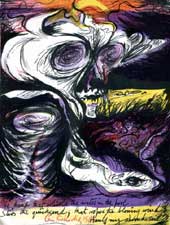
Poetry London, September-October 1947, three lithographs to the poem ' The force that through the green fuse drives the flower' by Dylan Thomas.
In 1962 Richards represented Great Britain at the Venice Biennale, and in 1981, ten years after his death in London, he was the subject of a major retrospective at the Tate Gallery. In
Ceri Richards
, to be published by Cameron and Hollis in July 2002 (distributed by Thames and Hudson, London) Mel Gooding traces the sources and course of his work and places it in its biographical, historical, artistic and intellectual contexts, with over 100 colour illustrations and a wealth of documentary photographs. It will be of the greatest interest to anybody interested in twentieth century European art, and win a new generation of admirers for a great artist.
Mel Gooding
READ ABOUT THE BOOK
LAUNCH HERE
|
|

Ceri Richards drawing of Dylan Thomas
FACTS:
- Ceri Richards was born in Wales in 1903, but he lived most of his life in London.
- Richards trained at the Royal College of Art in the mid-1920s.
- Ceri Richards represented Great Britain at the Venice Biennale in 1962.
-
The book -
'Ceri Richards
' by Mel Gooding will be published by Cameron and Hollis and will be released in July of 2002 by Thames and Hudson.
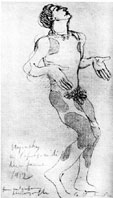
'Nijinsky', frontispiece, The Collected Poems of Vernon Watkins. Golgonooza Press 1986. (A drawing by Ceri Richards from 1912).

TO FIND OUT MORE
Visit the Glynn Vivian Gallery in Alexandra Road, Swansea, where a gallery has been dedicated to
Ceri Richards.

'The Ballad of The Outer Dark,' Vernon Watkins, front cover of dust jacket. Enitharmon Press 1979.
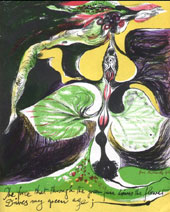
Poetry London, September-October 1947, three lithographs to the poem ' The force that through the green fuse drives the flower' by Dylan Thomas.
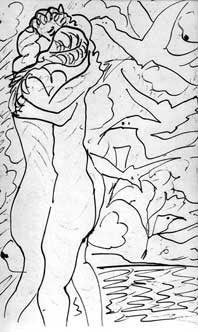
Drawings from the Collected Poems of Dylan Thomas

SPECIAL BOOK OFFER FROM DYLANS BOOKSHOP, SWANSEA
Roberto Sanesei : The Graphic Works of Ceri Richards.
Printed and published
in Milan 1973. Translated by Richard Burns. Large 4to, profusely illustrated
in colour and monochrome.
Out of Print,
an invaluable reference work and very hard to find.
We have a few copies only @ £150.
WITH TWO FINE SIGNED LITHOGRAPHS
ELEGIAC SONNET.
A large and stunning portfolio, sumptously produced in the
Immagini e Testi series , edited by Luigi Majno and Roberto Sanesi for
M'Arte Edizioni Milan 1970.
Each portfolio contains a lithographed reproduction of Vernon Watkins
original manuscript of his unpublished elegy for Dylan Thomas and two
beautiful original Ceri Richards Lithographs, numbered signed and dated. The
edition was of 149 copies only printed bt the Curwen Press.
We have the last few remaining portfolios of this late, and great work and
can offer them at £750.
http://www.dylans.com
Salubrious passage, Swansea SA1 3RT, Wales, UK.
Tel / Fax:
Mobile
|